Another Video, Same Broken Record: A Technical Rebuttal
Oh look, another enthusiastic YouTuber discovered Karpathy’s tweet and decided to make a tutorial. 14 million views in 72 hours! Lex Friedman does it too! “The smartest people in AI are doing this, so we probably should be too!”
Let me stop you right there. 🐑
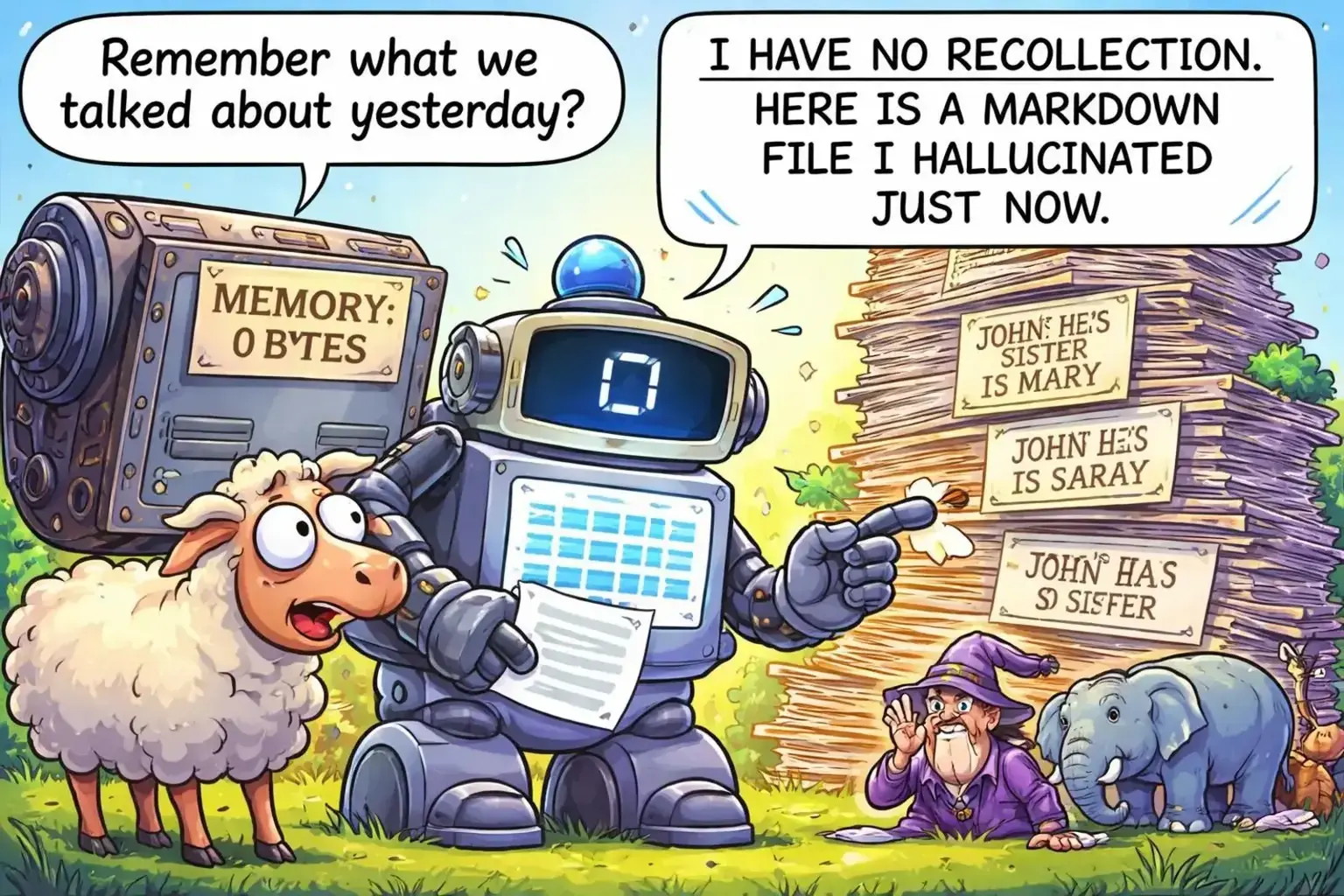
The Core Claims vs. Reality
Claim: “It never forgets anything. It gets stronger over time.”
Reality: The LLM has no persistent memory across sessions. It forgets everything between chats. The only “memory” is the markdown files it wrote last time. If those files contain errors, contradictions, or hallucinations, the LLM will confidently repeat them. That’s not “getting stronger.” That’s a landfill with hyperlinks.
Claim: “It solves the problem of LLMs knowing only aggregate information.”
Reality: The solution is to feed the LLM your own sources. That’s fine. But then the LLM writes markdown summaries that replace those sources. Now you have two versions of “truth” — the original and the LLM’s hallucinated version. When they diverge, which one wins? The video doesn’t say.
Claim: “You can ask complex questions across all sources.”
Reality: You can ask. Whether you get a correct answer depends on whether the LLM hallucinated, whether the index fit in context, whether the wiki pages contain contradictions, and whether the LLM chose the right pages to read. That’s not “complex question answering.” That’s probabilistic gambling with your knowledge.
Claim: “Claude reads every file and creates a structured wiki.”
Reality: Claude reads every file within the context window. The video used 10 resources. At 100 resources, the context window overflows. The pattern admits this and adds qmd (BM25 + vector search). That’s not “no embeddings.” That’s embeddings with extra steps.
Claim: “It’s way easier, quicker, and more efficient to get information. You’re not going to use a bunch of tokens once you have the index built out.”
Reality: The index itself consumes tokens. Every query still requires the LLM to read relevant pages. At scale, with constant updates and queries, token usage is not “way easier.” It’s unpredictable and potentially expensive. The video conveniently doesn’t show the API bill.
Claim: “Ask where the gaps are in my wiki. It will suggest things to add.”
Reality: The LLM suggests gaps based on its training data, not based on actual missing knowledge. It doesn’t know what you don’t know. It predicts plausible-sounding gaps. You might add them. Now your wiki contains speculative information presented as authoritative. That’s not “self-improvement.” That’s self-contamination.
Claim: “Lex Friedman feeds it into voice mode and chats with his wiki on long runs.”
Reality: That’s a cool demo. It’s also a great way to internalize whatever hallucinations the LLM embedded in the wiki. The Feynman technique requires explaining to a real audience that can push back. Chatting with an LLM that agrees with everything you say is not learning. It’s a circle jerk with extra steps.
What the Video Doesn’t Show
| Missing Piece | Why It Matters |
|---|---|
| What happens at 1,000 files? | The index breaks. You need qmd (embeddings). |
| Who fixes broken links? | The LLM might, but it also might not. |
| Who resolves contradictions? | The video says the LLM flags them. It doesn’t say who resolves them. |
| Who merges duplicate pages? | No one. Your wiki will have 47 pages about “mechanical tension” with slightly different names. |
| Who sets permissions? | No one. The LLM sees everything. |
| What’s the API cost at scale? | Not mentioned. |
| What happens when the LLM hallucinates a source? | Not mentioned. |
| How do you audit the wiki’s correctness? | Not mentioned. |
The actual video
The Technical Bottom Line
The video is a well-produced tutorial for a prototype that works with 10 files. The problems appear at 100 files. The system collapses at 1,000 files. The pattern admits this and adds embeddings. The video ignores this and calls it “no embeddings.”
The LLM has no memory. The wiki has no foreign keys. The system has no permissions. The human still fixes the mess.
But sure, “the smartest people in AI are doing it.” Appeal to authority doesn’t fix broken architecture. 🐑💀
Build a real knowledge base. Use PostgreSQL. Add foreign keys. Implement permissions. Track versions. Extract metadata deterministically. Let the LLM write descriptions — not replace your sources.
The video is entertaining. The pattern is still a trap. The sheep are still lining up.
Don’t be a sheep. 🧙🐘
⚠️ THE WORD “WIKI” HAS BEEN PERVERTED ⚠️
Related pages
- Shepherd's LLM-Wiki vs. Robust Dynamic Knowledge Repository: A Satirical Allegory on AI-Generated Knowledge Management
 This satirical allegory critiques the trend of relying on Large Language Models (LLMs) to automatically generate and manage knowledge bases using simple Markdown files, portraying this approach as a naive "Shepherd's" promise that inevitably leads to data inconsistency, hallucinations, privacy leaks, and unmanageable maintenance. The text contrasts this fragile, probabilistic "LLM-Wiki" method with a robust, 23-year-old "Dynamic Knowledge Repository" (DKR) built on structured databases (like PostgreSQL) and Doug Engelbart's CODIAK principles, arguing that true knowledge management requires human curation, deterministic relationships, and explicit schemas rather than blindly following AI-generated text files.
 - Karpathy's LLM-Wiki Is a Flawed Architectural Trap
 The author sharply criticizes Andrej Karpathy's viral "LLM-Wiki" concept as a flawed architectural trap that mistakenly treats unstructured Markdown files as a robust database, arguing that relying on LLMs to autonomously generate and maintain knowledge leads to hallucinations, broken links, privacy leaks, and a loss of human cognitive engagement. While acknowledging the appeal of compounding knowledge, the text asserts that Markdown lacks essential database features like referential integrity, permissions, and deterministic querying, causing the system to collapse at scale and contradicting its own "zero-maintenance" promise. Ultimately, the author advocates for proven, structured solutions using real databases and human curation, positioning LLMs as helpful assistants rather than autonomous masters, and warns against blindly following a trend promoted by someone who has publicly admitted to being in a state of psychosis.
 - Critical Rebuttal to LLM-Wiki Video: Why Autonomous AI Claims Are Misleading
 The text provides a critical rebuttal to a video promoting "LLM-Wiki," arguing that the system’s claims of autonomous intelligence, zero maintenance costs, and scalability are fundamentally misleading. The critique highlights that LLMs lack persistent memory, leading to repeated errors, while the system’s actual intelligence is merely increased data density rather than genuine understanding. Furthermore, the video ignores significant practical challenges such as substantial API costs, the inevitable need for embeddings at scale, the complexity of fine-tuning, and the persistent human labor required for data integrity and contradiction resolution. Ultimately, the author concludes that the video is merely a tutorial for a fragile prototype that fails to address critical issues like version control, access management, and long-term viability.
 - The LLM-Wiki Pattern: A Flawed and Misleading Alternative to RAG
 The text is a scathing critique of the "LLM-Wiki" pattern, arguing that its claims of being a free, embedding-free alternative to RAG are technically flawed and misleading. The author contends that the system inevitably requires vector search and local indexing tools (like qmd) to scale, fundamentally contradicting the "no embeddings" premise, while also failing to preserve source integrity by retrieving from hallucinated LLM-generated summaries rather than original documents. Furthermore, the approach is deemed unsustainable due to hidden API costs, the inability of LLMs to maintain large indexes beyond small prototypes, and the lack of essential database features like foreign keys and version control, ultimately positioning it as a fragile prototype rather than a viable production knowledge base.
 - Why Graphify Fails as a Robust LLM Knowledge Base
 The text serves as a technical rebuttal to a tutorial promoting "Graphify" as a robust implementation of Karpathy’s LLM-Wiki pattern, arguing that the video misleadingly oversimplifies the system’s capabilities and scalability. It highlights that Graphify is not merely a simple extension but a computationally heavy architecture lacking critical production features such as data integrity, contradiction resolution, permission management, and verifiable entity extraction, while the underlying LLM possesses no true persistent memory. The author contends that the tool is merely a small-scale prototype that accumulates noise rather than compounding knowledge, and concludes by advocating for a more rigorous approach to building knowledge bases using traditional databases like PostgreSQL with deterministic metadata extraction and proper relational constraints.
 - LLM Wiki vs RAG: Why RAG Wins for Production Despite LLM Wiki's Knowledge Graph Appeal
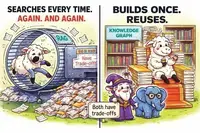 While a recent video by "Data Science in your pocket" offers a balanced comparison between LLM Wiki and RAG by highlighting LLM Wiki’s ability to build structured, reusable knowledge graphs versus RAG’s repetitive, stateless retrieval, it ultimately fails to address critical production flaws. The author argues that LLM Wiki is currently a fragile prototype rather than a robust architecture, lacking essential database features like foreign keys, referential integrity, access controls, and deterministic metadata extraction. Consequently, while LLM Wiki may suit personal knowledge building, its susceptibility to error propagation, high maintenance costs, and lack of true memory make RAG the superior choice for reliable, production-ready systems, with a hybrid approach recommended for optimal results.
 - Why LLM Wiki Fails as a RAG Replacement: Context Limits and Data Integrity Issues
 The text serves as a technical rebuttal to a video claiming that "LLM Wiki" renders Retrieval-Augmented Generation (RAG) obsolete, arguing instead that LLM Wiki is merely a rebranded, less robust version of RAG that fails at scale due to context window limitations and lacks true persistent memory or data integrity. The author highlights that LLM Wiki relies on static markdown files which cannot enforce database constraints, resolve contradictions, or prevent hallucinations from becoming "solidified" errors, ultimately requiring the same search mechanisms and human maintenance that RAG avoids. The conclusion emphasizes that while context engineering is valuable, it should be supported by proper databases with foreign keys and version control rather than fragile markdown repositories, urging developers to use LLMs as tools for processing rather than as the foundation for knowledge storage.
 - Critique of LLM Wiki Tutorial: Limitations and Production Readiness
 The technical evaluation critiques the LLM Wiki tutorial for misleading claims that AI eliminates maintenance friction and provides persistent memory, revealing instead that the system relies on static markdown files with no referential integrity, privacy controls, or error-checking mechanisms. While the video correctly advocates for separating raw sources from generated content and using schema files, it critically omits essential issues such as hallucination propagation, silent link breakage, lack of version control for individual facts, scaling limits requiring RAG, and ongoing API costs. Ultimately, the tutorial is deemed suitable only as a small-scale personal prototype requiring active human supervision, rather than a robust, production-ready knowledge base.
 - LLM Wiki vs Notebook LM: Hidden Costs Privacy Tradeoffs and the Hybrid Approach
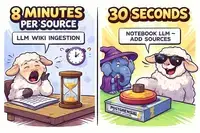 This video offers a rare, honest side-by-side evaluation of LLM Wiki and Notebook LM, correctly highlighting LLM Wiki’s significant hidden costs—including slow ingestion times, high token usage, and poor scalability beyond ~100 sources—while acknowledging Notebook LM’s speed and ease of use. However, the review understates critical privacy and ownership trade-offs, specifically that Notebook LM processes data on Google’s servers (posing risks for sensitive information) and lacks user control, whereas LLM Wiki’s maintenance burden is the price for local data sovereignty. Ultimately, the creator recommends a pragmatic hybrid approach: using Notebook LM for quick exploration and LLM Wiki for deep, long-term academic research, emphasizing that the goal should be actionable knowledge rather than just building a wiki.
 - Debunking Karpathy's LLM Wiki: The Truth Behind the Self-Healing Marketing Hype
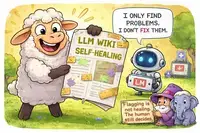 The video is a heavily hyped marketing pitch for Karpathy’s "LLM Wiki" that misleadingly claims the system is "self-healing" and autonomous, while in reality, it relies on static files, requires significant human intervention for maintenance, and lacks true memory or self-correction capabilities. The presentation ignores critical technical limitations such as token costs, scale constraints beyond ~100 sources, privacy risks, and the potential for hallucinations, ultimately presenting a flawed RAG-based solution as a revolutionary upgrade without acknowledging its trade-offs or the substantial effort required to keep it functional.
 - LLM Wiki Pattern: A Balanced Review Highlighting Limitations and Operational Challenges
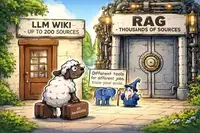 This video provides a balanced and honest introduction to the "LLM Wiki" pattern, correctly identifying its limitations to personal scales (100–200 sources) and acknowledging that RAG remains superior for larger datasets. While it avoids the hype and sales tactics of other videos by clearly explaining the system’s transparency, portability, and immutable source practices, it significantly understates critical operational challenges. The review notes that the video fails to address essential practical issues such as token costs, lengthy ingest times, the human maintenance burden required to resolve contradictions and broken links, and privacy concerns, making it a good conceptual overview but insufficient for understanding the full technical and financial realities of implementation.
 - Why LLM Wiki Is a Bad Idea: A Critical Analysis of Flaws and RAG Alternatives
 The video "Why LLM Wiki is a Bad Idea" provides a strong, technically accurate critique of the LLM Wiki approach, correctly identifying eight major flaws including error propagation, structured hallucinations, information loss, update rigidity, and scalability issues, while recommending a hybrid RAG-based system. Although it overstates the difficulty of updates by implying full graph rebuilds and unfairly ignores RAG’s own costs and hallucination risks, it remains the most direct and valuable critical resource for understanding the significant pitfalls of relying solely on LLM-generated structured knowledge bases.
 - Why Adam's LLM Wiki in Business Implementation Fails as a Production Framework
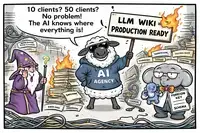 Adam’s "LLM Wiki in Business" implementation fundamentally fails as a production framework because it exhibits every critical flaw identified in the opposing critique, including error propagation, hallucination structuring, information loss, and a lack of provenance or security. By relying on unstructured folders and rigid JSON schemas instead of a proper database with foreign keys, audit trails, and scalable retrieval mechanisms, Adam’s system violates all four essential pillars of reliable knowledge management (Store, Relate, Trust, Retrieve) and admits its own inability to scale beyond a small number of clients. Consequently, the analysis concludes that Adam’s approach is not a superior alternative to RAG, but rather an unintentional case study demonstrating why LLM Wiki is a flawed and risky strategy for business applications requiring accuracy, security, and scalability.
 - Critical Evaluation of Local LLM Wiki with Obsidian: Fundamental Flaws and Business Unsuitability
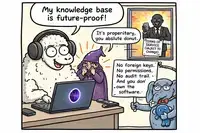 The evaluation concludes that the "Local LLM Wiki with Obsidian" tutorial fails all four fundamental pillars of a robust knowledge base—Store with Integrity, Relate with Precision, Trust with Provenance, and Retrieve with Speed—due to its reliance on unstructured markdown files lacking foreign keys, immutability, typed relationships, audit trails, and queryable SQL capabilities. Although the creator is praised for intellectual honesty and transparency about the prototype’s limitations, the architecture remains fundamentally flawed, and the use of proprietary software (Obsidian) introduces critical risks including vendor lock-in, telemetry concerns, zero access control, and the absence of multi-user support, rendering it unsuitable for any business, collaborative, or sensitive use cases despite its appeal as a personal hobby tool.
 - James' LLM Wiki Fails Robust Knowledge Management Due to Lack of Database Integrity
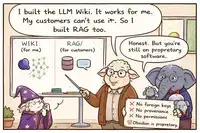 The evaluation concludes that while James from Trainingsites.io offers a rare, pragmatic, and honest assessment by correctly distinguishing between using an LLM Wiki for personal organization and RAG for customer-facing queries, his implementation fundamentally fails the four pillars of robust knowledge management: Store with Integrity, Relate with Precision, Trust with Provenance, and Retrieve with Speed. By relying on proprietary Obsidian and markdown files rather than a real database, his system lacks foreign keys, immutability, provenance tracking, access controls, and queryability, making it structurally unsound for professional or collaborative use despite its effectiveness as a personal browsing tool.
 - Memex: Advanced LLM Wiki with Critical Database Limitations
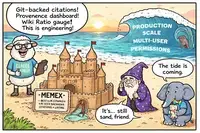 Memex is a sophisticated LLM Wiki implementation that stands out for its thoughtful mitigations of common pitfalls, such as git-backed versioning, inline citation tracking, provenance dashboards, and contradiction policies. However, despite being the most advanced attempt in this space, it fundamentally fails the "Four Pillars" of a proper knowledge base because it relies on markdown files rather than a relational database. This architectural choice results in critical limitations: it lacks foreign keys (leading to broken citations on renames), has no permissions or access control, supports only text data, and provides non-deterministic, LLM-mediated retrieval instead of precise SQL queries. Consequently, while Memex is an excellent personal research tool, it is not production-ready for collaborative, secure, or enterprise use cases that require data integrity and structured querying.